
Michael addition / Asymmetric Michael Addition is one of the most frequently used C-C bond-forming reactions in...
Buchler Glossary
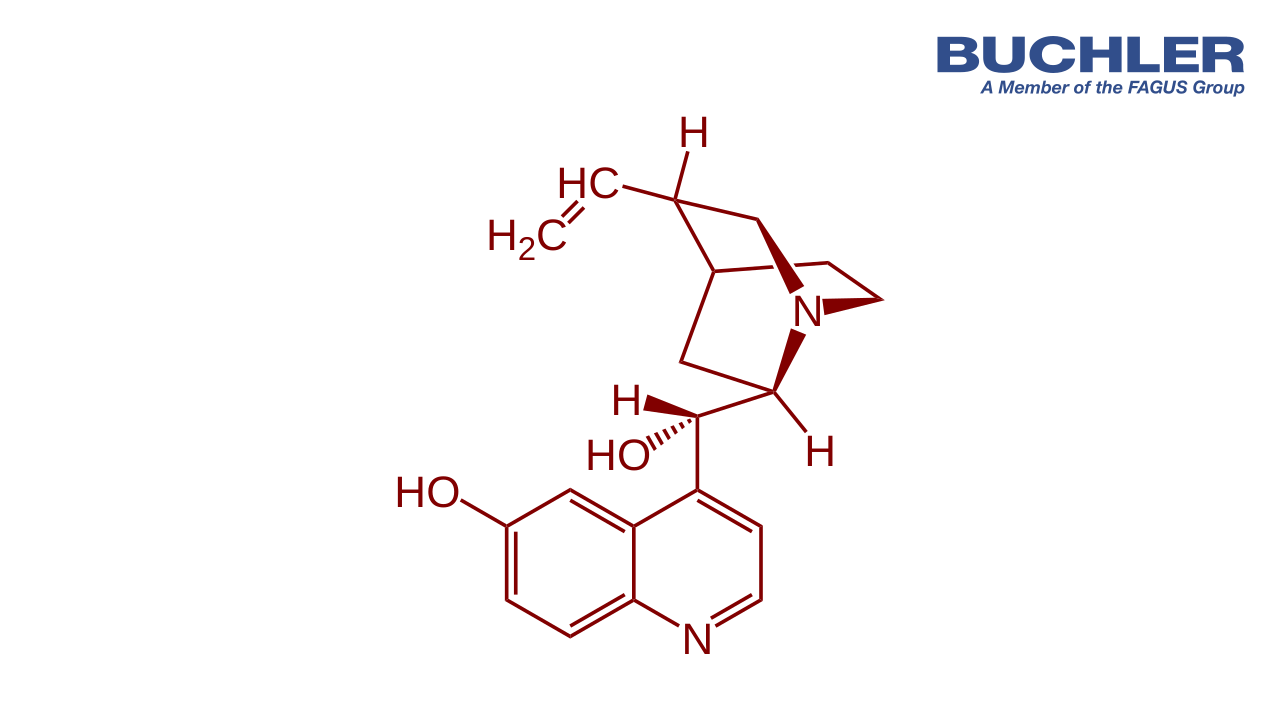
Cupreidine (CAS-No. 70877-75-7)
Cupreidine Base (CAS-No. 70877-75-7), as well as the pseudoenantiomer Cupreine, belong to an emerging class of bifunctional highly enantioselective organocatalysts. They can be used for a wide range of asymmetric reactions.
Similar to the amino group of 6´-Aminocinchonine the hydroxy group proves crucial to obtain high enantioselectivity in many synthetically relevant reactions like Michael additions, Henry, Diels-Alder, Friedel-Crafts, Fluorination, Amination, Alkylation, Bromolactonization etc. despite its position far away from the stereocenters. Usually the electrophile is activated via the C6`-hydroxy group. On the other hand the free C6’ hydroxy group can be further functionalized to improve catalytic performance. The key step of Indoxacarb is a α-hydroxylation of a β-ketoester. Higher enantiomeric excesses can be obtained with Cupreidine compared to Cinchonine. Cupreidine as a derivative of Quinidine is also widely used as a racemic resolution agent.
For more detailed information about the application of Cupreidine (CAS-No. 70877-75-7) please enter into our free of charge chiral catalyst database.
Further Articles:
Asymmetric Synthesis
Asymmetric synthesis, also called enantioselective synthesis, is a form of chemical synthesis. It is defined by IUPAC...
Atropisomers
The chirality of atropisomers is originating from restricted rotations along chemical single bonds. Atropisomers are...
Bargellini reaction
The original Bargellini reaction (1906) was a mixture of the reagents phenol, chloroform, and acetone in the presence...
Barton-Zard Reaction
The Barton-Zard reaction is a route to pyrrole derivatives via the reaction of a nitroalkene with an α-isocyanoacetate...